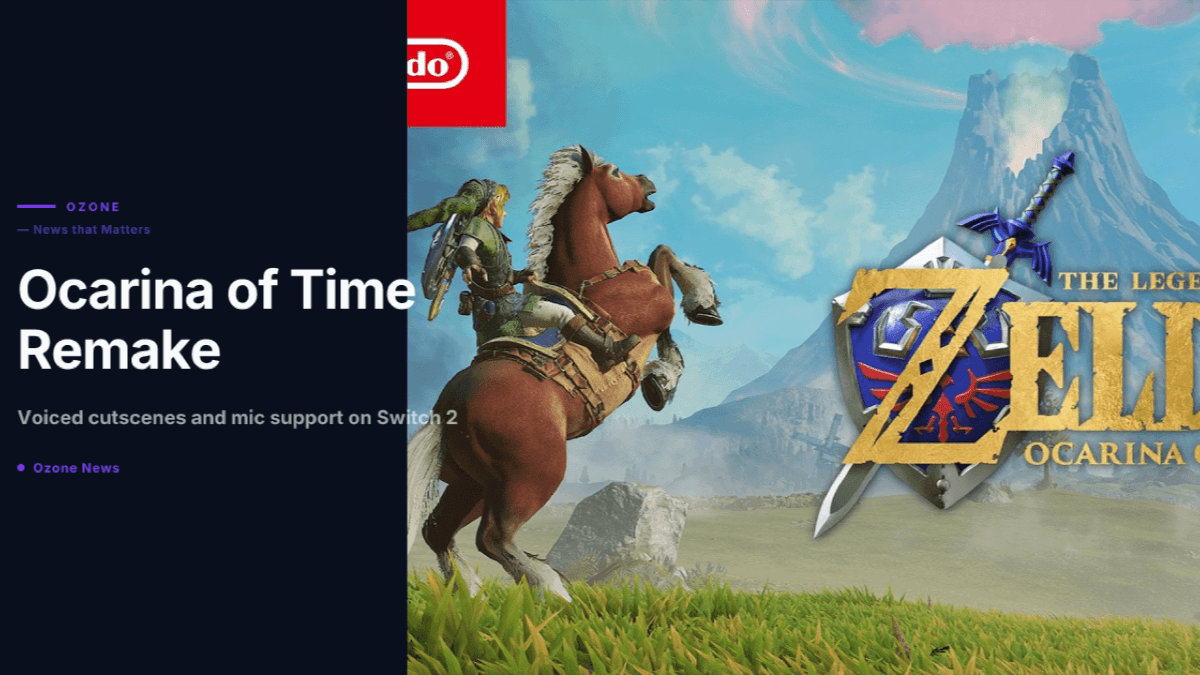
Less than a week before its launch, Nintendo is showing players exactly how much The Legend of Zelda: Ocarina of Time has changed in its jump to the current generation.
Built from the ground up for the Nintendo Switch 2, the remake of the 1998 Nintendo 64 classic releases on November 5, 2026. The company's new overview video, rounded up by Nintendo Life, walks through eight changes, and the list makes one thing clear: this is not a visual remaster with the 1998 control scheme left intact. For the hardware context around the release, see our Switch 2 price drop coverage, which landed days ahead of launch.
Modernized controls, voice acting and camera work
The most immediate change is how the game plays. Nintendo confirms Link can now jump and dash, replacing the stiff movement that defined the original, and the remake pairs that with modern camera movement rather than the fixed angles players memorized on the N64.
Ranged weapons such as the Fairy Bow and the Hookshot can be aimed with button controls or with motion controls, a choice players toggle in the options menu rather than a forced gimmick. Presentation gets the same overhaul treatment. Nintendo's store page lists voice acting, completely overhauled visuals and orchestral music, along with expanded cutscenes and new and expanded dialogue from characters across Hyrule.
The remake stays faithful underneath the polish. Areas like Zora's Domain, Goron City and Lake Hylia keep their core geography, as do the Forest, Fire and Shadow Temples and Dodongo's Cavern, though Hyrule Field gains terrain variation the original hardware could not render.
Play the Ocarina with your own voice
The most distinctive addition uses hardware the N64 version never had access to.
Players are not locked into button combinations for magical melodies. Nintendo confirms you can play the Fairy Ocarina or the Ocarina of Time by humming, or even playing a real instrument, into the Nintendo Switch 2 microphone. When the game recognizes a song Link has learned, such as the Song of Storms or Zelda's Lullaby, it fires the effect, whether that means changing the weather, shifting day to night or opening a new path.
Navi has a similar new role. Beyond combat hints, she can surface fairy thoughts and memories scattered across Hyrule that Nintendo says contain special secrets.
Threads of Time and the Hall of Fallen Foes
The overview trailer also introduced two additions that did not exist in the original.
The Hall of Fallen Foes is an interactive museum located somewhere in Hyrule. It holds statues of the enemies Link defeats during the adventure, with information about each one, and it lets him trigger rematch battles against bosses on a timer, which makes it the spiritual successor to the boss challenge mode in Ocarina of Time 3D. Speedrunners have good reason to pay attention.
The Threads of Time is the other new mode, and Nintendo has not yet described how it works beyond confirming it exists.
Launch times, editions and amiibo
There is no Deluxe Edition and no paid early access window, so the only choice is digital or physical. VICE notes that Nintendo's support guidance typically unlocks digital games that also have a physical release at 9:00 PM Pacific the night before the listed date, which puts North American eShop buyers into Hyrule on the evening of November 4, with the UK, Europe, Japan and Australia opening at midnight on November 5.
Buyers who want the collector's packaging should move quickly. Nintendo says the textured gold foil cover ships with the first print run only, while supplies last. Digital purchasers have a separate incentive: buying on the eShop before 11:59 PM PT on November 23, 2026 earns a Legend of Zelda 40th Anniversary wallpaper.
amiibo are supported across the board, with any Zelda series figure granting in-game extras, while the new Young Link and Young Zelda figures scheduled for 2027 unlock masks that render Link in a retro graphical style. The game also supports HDR output, VRR and linear PCM surround sound on compatible televisions, and a Nintendo Switch Online membership is required only for Save Data Cloud backup.